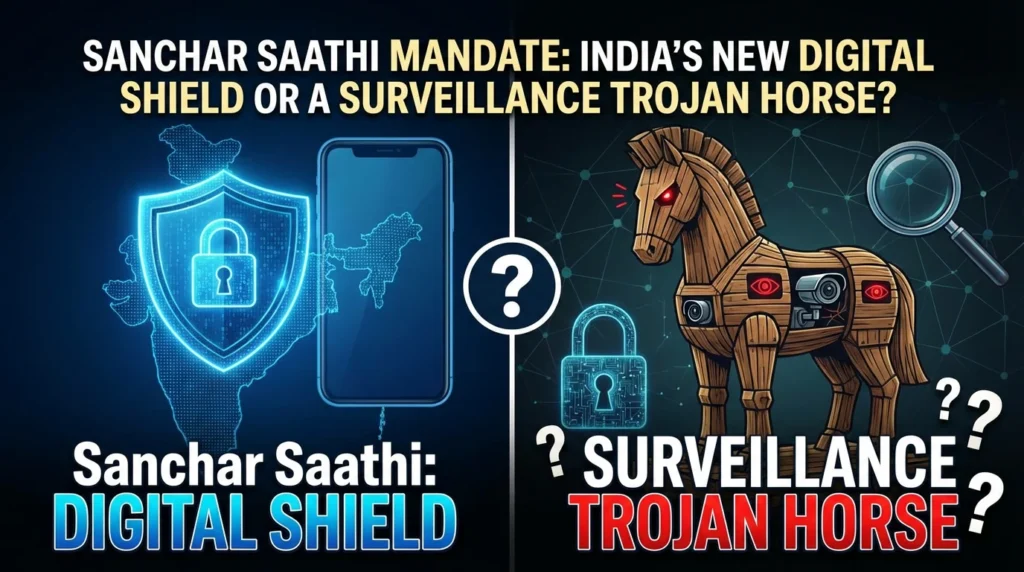

Sanchar Saathi Mandate: India’s New Digital Shield or a Surveillance Trojan Horse?
In a move aimed at bolstering national telecom security, the Indian government has mandated the pre-installation of its Sanchar Saathi application on all new smartphones sold in the country starting in 2025. While lauded by officials as a critical tool for cyber safety, the directive has ignited a firestorm of debate, pitting the government’s security agenda against fundamental user rights and raising significant privacy concerns among citizens, tech giants, and political opposition.
The Promise of a Safer Digital Space
Launched initially as a web portal in May 2023 and followed by a mobile app in January 2024, Sanchar Saathi was developed by the Department of Telecommunications (DoT) as a one-stop platform for Indian mobile users. Its stated mission is to empower citizens to protect their digital identity and combat the rising tide of digital crime. The platform offers a suite of services designed for proactive mobile fraud prevention. A key feature, ‘Chakshu’, allows users to report suspicious calls, SMS, and even WhatsApp messages directly to authorities. The app also enables users to report international calls that are deceptively masked as local Indian numbers, a common tactic used by scammers. Beyond fraud reporting, its functionalities include tools for device tracking to locate and block lost or stolen smartphones, and a system for IMEI verification to check the validity of a device before purchase. The government has promoted the app’s success, reporting that it has already assisted in the recovery of over 700,000 lost or stolen phones since its launch.
The Controversial Mandate
The issue escalated in November 2025 when the government announced that Sanchar Saathi must be pre-installed on all new smartphones, giving manufacturers a 90-day window to comply. The initial directive was particularly alarming, as it stipulated that the government app could not be disabled or uninstalled by the user. This non-negotiable approach immediately sparked a public outcry, with critics labeling it a breach of consumer choice and a potential pathway for state surveillance. Facing intense criticism, Communications Minister Jyotiraditya Scindia issued a clarification, stating that users would, in fact, be free to delete or deactivate the app if they chose. While this concession softened the government’s stance, it did little to quell the deeper unease surrounding the mandate.
The Unsettling Privacy Questions
The core of the opposition rests on profound privacy concerns. Security experts point out that for the government app to perform its functions, such as comprehensive device tracking, it requires elevated system permissions. This deep-level access allows the application to monitor a significant amount of device data, raising questions about what information is collected, how it is used, and who has access to it. These fears are compounded by India’s legal framework. The country’s Data Protection Act includes provisions that exempt government agencies from strict data protection norms, permitting them to collect user data without explicit notification under certain circumstances. This legal loophole creates a scenario where a state-mandated app with high-level permissions could potentially operate without the oversight and transparency expected in a democracy.
A Standoff with Big Tech and Political Opposition
The mandate has not only worried citizens but has also created a potential standoff with global technology companies. Apple, a company that has built its brand on a strong pro-privacy stance, has reportedly refused to comply with the directive, viewing it as a violation of its user privacy principles. Such a refusal from a major market player complicates the government’s implementation plan and highlights the global friction between national security measures and standardized privacy policies. The issue has also taken on a political dimension. The Indian National Congress, the country’s main opposition party, has publicly demanded that the mandate be rolled back entirely, framing it as an authoritarian overreach. The debate now encapsulates a critical question for modern India: how does a nation enhance telecom security and promote cyber safety without compromising the privacy and freedom of its citizens? The Sanchar Saathi saga has become a crucial test case for the future of digital identity and state authority in the world’s largest democracy.
Conclusion
Sanchar Saathi stands at a crossroads. On one hand, it presents a powerful government-backed solution for critical issues like mobile fraud prevention and theft recovery. On the other, its mandatory installation, coupled with extensive permissions and a permissive legal environment for state data collection, has positioned it as a symbol of potential surveillance. As the compliance deadline approaches, the government must navigate the delicate balance between securing its digital borders and respecting the digital rights of over a billion people. The outcome will likely set a significant precedent for the relationship between the state, technology, and privacy in India for years to come.
References
- https://www.ndtv.com/india-news/sanchar-saathi-explained-what-it-is-and-why-it-is-being-made-mandatory-9734512
- https://en.wikipedia.org/wiki/Sanchar_Saathi
- https://en.vikaspedia.in/viewcontent/e-governance/mobile-governance/sanchar-saathi-portal
- https://www.thepresspad.com/post/sanchar-saathi-mandatory-installation-explained-what-it-means-for-users-privacy-smartphones-ind
- https://www.techcircle.in/2025/12/02/sanchar-saathi-app-sparks-privacy-row-govt-issues-clarification
- https://www.engadget.com/big-tech/apple-will-reportedly-refuse-to-pre-install-indias-state-mandated-security-app-143050110.html