
New Delhi | December 2025:
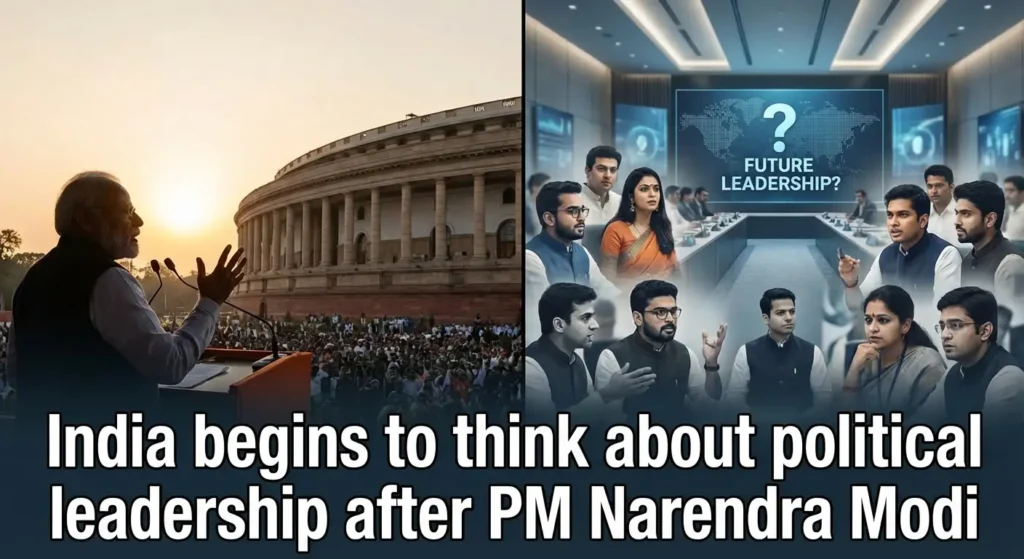
India is beginning to think seriously about India political leadership after PM Narendra Modi, even as he continues to lead the country with full authority. The shift is gradual, but unmistakable. Political parties, institutions, and global observers are now looking beyond the present, focusing on continuity and stability in the years ahead.
There is no immediate change in leadership. PM Modi remains firmly in control. But the conversation itself signals long-term planning in Indian politics.
What Happened
After more than a decade of Narendra Modi’s leadership, discussions around political succession in India have started surfacing within political circles. These talks are not public announcements or challenges to authority. They are internal, strategic, and forward-looking.
Within the BJP, Modi remains the undisputed leader. Still, party meetings increasingly touch on organisational depth, future leadership roles, and governance beyond a single figure. This reflects a broader effort to strengthen leadership continuity.
According to a report by Reuters, international investors and policymakers are closely watching how India prepares for a post-Modi phase, given his central role in shaping the country’s political and economic direction.
Source: https://www.reuters.com
Why This News Matters
The discussion on India political leadership after PM Narendra Modi matters because his leadership has defined an entire era. From welfare delivery and infrastructure growth to foreign policy outreach, Modi’s influence runs deep.
A future leadership transition will affect:
- Indian democracy and institutions
- Economic confidence and policy stability
- India’s global standing
- Centre–state political relations
Strong democracies plan for leadership change early. These discussions help reduce uncertainty and reinforce trust in institutions.
Key Details You Should Know
- PM Narendra Modi continues as Prime Minister with full mandate
- No official succession plan has been announced
- The post-Modi leadership debate is informal and long-term
- Opposition parties are reshaping strategies for the future
- Global media is tracking India’s political signals
- Official confirmation on timelines is awaited
This makes it clear that the process is about preparation, not transition.
What Happens Next
In the near term, governance remains unchanged. PM Modi continues to lead policy decisions, election planning, and international diplomacy.
Gradually, however, political observers expect:
- Greater visibility for senior ministers and state leaders
- Stronger focus on the BJP leadership pipeline
- Broader participation in national policy debates
As reported by The Indian Express, opposition parties see this phase as an opportunity to rebuild leadership credibility, though no single national alternative has emerged so far.
Source: https://indianexpress.com
Upcoming elections and parliamentary sessions will offer early signs of how ready India is for leadership beyond Modi.
Public Reaction and Wider View
Public reaction remains steady. Many voters still associate stability and governance delivery with Modi’s leadership. At the same time, there is growing awareness that leadership change is inevitable.
A recent analysis by BBC News noted that India’s real test lies in managing future Indian leadership through institutions rather than individuals.
Source: https://www.bbc.com
This view reflects a broader belief that preparation strengthens democracy.
Final Paragraph
India thinking about political leadership after PM Narendra Modi reflects foresight, not uncertainty. Modi remains firmly in charge, and no immediate shift is underway. Yet the quiet discussions across parties and institutions show that India is preparing for the future. How smoothly this planning turns into continuity will shape the next chapter of Indian politics.