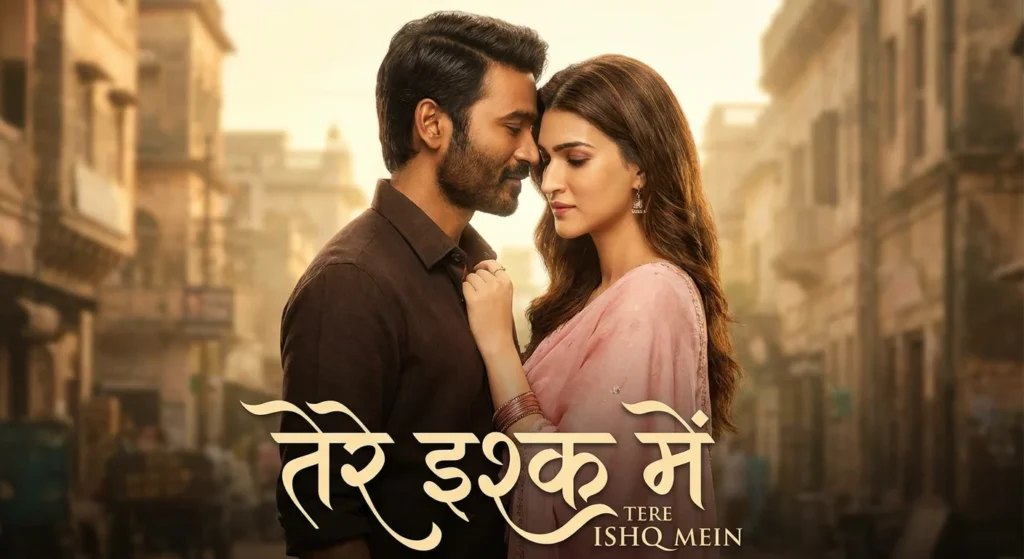

NEW DELHI – Director Aanand L Rai’s much-anticipated film, Tere Ishq Mein, starring Dhanush and Kriti Sanon, has arrived in theaters, immediately sparking conversation with its raw and turbulent portrayal of love and obsession. Billed as an intense romantic drama, the film plunges viewers into a complex relationship that tests the boundaries between passion and toxicity, leaving audiences both captivated and unsettled.
The tere ishq mein movie reunites director Rai with actor Dhanush, a collaboration that previously yielded the critically acclaimed and commercially successful *Raanjhanaa*. Set against the visually contrasting backdrops of spiritual Banaras and stark Ladakh, the story follows Shankar (Dhanush), a hot-headed Air Force pilot, and Mukti (Kriti Sanon), a psychologist. The narrative unfolds as Shankar, grounded for disobedience, undergoes a psychological evaluation by Mukti, triggering flashbacks to their volatile college romance where her attempts to reform his aggressive nature led to a deeply passionate but destructive bond.
Early reactions and any initial tere ishq mein review have been quick to praise the powerhouse performances from its leads. Dhanush is noted for his compelling portrayal of Shankar’s fierce, obsessive love, a role that echoes the intensity of his character in *Raanjhanaa*. Kriti Sanon delivers a nuanced performance as Mukti, a character grappling with her own internal struggles while navigating Shankar’s overwhelming personality. The supporting cast, including Prakash Raj as Shankar’s father and a cameo by Mohammad Zeeshan Ayyub, provides solid depth to the narrative.
Despite the strong acting, the film’s thematic core has drawn mixed reactions. Many critics describe the story as emotionally potent but also uneven and messy, challenging viewers with its morally ambiguous characters. The central conflict in tere ishq me has prompted comparisons to films like *Kabir Singh*, reigniting debates about the romanticization of toxic relationships in Indian cinema. The film does not offer a simple love story but rather a complex, and at times uncomfortable, exploration of emotional pain and transformation.
A significant highlight of the film is its musical score, composed by the legendary A.R. Rahman with poignant lyrics by Irshad Kamil. The title track, “Tere Ishk Mein,” sung by Arijit Singh, has already become a chart-topper, lauded for its soulful melody that captures the film’s essence of longing and heartache. Songs like “Aawaara Angaara” are woven into the narrative to amplify the story’s emotional weight, showcasing Rahman’s signature ability to create a powerful auditory experience.
Commercially, the film has shown strong potential. The official tere ishq mein release date of November 28, 2025, was met with high anticipation, reflected in robust advance booking numbers across the country. The film’s appeal is particularly strong in Tier-2 and Tier-3 cities, where audiences have historically shown a significant appetite for emotionally charged dramatic stories. While the official tere ishq mein budget has not been publicly disclosed, industry analysts are keenly watching the tere ishq mein box office collection, expecting the film to perform well despite its divisive themes. The final tere ishq mein collection will likely depend on word-of-mouth and the audience’s willingness to engage with its challenging subject matter.
Ultimately, this dhanush new movie stands as a bold, melodramatic piece of cinema. It is a romantic drama that forgoes a feel-good narrative in favor of a darker, more complex examination of human emotion. A comprehensive tere ishq mein movie review must acknowledge its ambition to tackle difficult themes head-on. *Tere Ishq Mein* is a film designed to be felt and debated, cementing its place as one of the most talked-about releases of the year.

