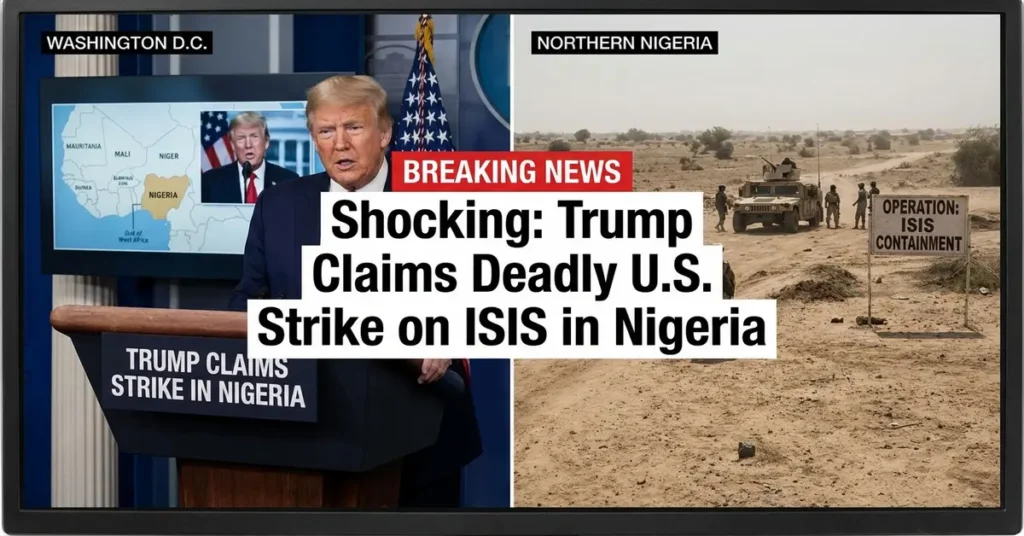

Trump’s Claim of a Deadly U.S. Strike on ISIS in Nigeria
On December 25, 2025, former President Donald Trump made a bold claim regarding a deadly U.S. strike against ISIS targets in Nigeria. He stated, “Tonight, at my direction as Commander in Chief, the United States launched a powerful and deadly strike against ISIS Terrorist Scum in Northwest Nigeria, who have been targeting and viciously killing, primarily, innocent Christians.” This statement was shared on his Truth Social account and quickly picked up by major news outlets.
The strike reportedly took place in Sokoto State, a region that has seen increasing violence from ISIS-affiliated groups. While Trump’s announcement was met with mixed reactions, the U.S. Africa Command (AFRICOM) confirmed that the operation was conducted at the request of Nigerian authorities, stating that it resulted in the deaths of multiple ISIS terrorists.
However, the details surrounding the military action remain murky. U.S. officials described the operation as “numerous perfect strikes,” but did not specify whether it involved airstrikes, drone strikes, or special operations. The lack of transparency has raised questions about the nature of the operation and its effectiveness.
Reactions to the U.S. Strike in Nigeria
The Nigerian government acknowledged the strike, emphasizing that it was aimed at safeguarding all citizens, regardless of faith. President Bola Ahmed Tinubu called for peace and religious harmony, stating, “I stand committed to protecting Christians, Muslims, and all Nigerians from violence.” This statement highlights the complex religious dynamics in Nigeria, where violence affects both Christians and Muslims.
Despite the official confirmations, independent verification of the strike’s impact has been lacking. Major news organizations, including Reuters and CNN, reported that there were no observable signs of the strike on the ground, such as blast signatures or casualty figures. Local journalists have also noted the absence of evidence supporting the claims of a significant military operation.
The strike is part of a broader U.S. counter-terrorism strategy in Nigeria, which has included drone surveillance and limited airstrikes against ISIS-affiliated groups in the region. The U.S. has been involved in training Nigerian forces and providing intelligence support to combat the growing threat of terrorism.
As the situation unfolds, the implications of Trump’s claims and the U.S. military actions in Nigeria will continue to be scrutinized. The lack of independent verification raises concerns about the accuracy of the information being disseminated and the potential for misinformation.
In conclusion, while Trump’s assertion of a deadly U.S. strike against ISIS in Nigeria has been officially acknowledged, the absence of detailed operational data and independent verification leaves many questions unanswered. The humanitarian impact remains unclear, and the narrative surrounding the strike is complicated by the religious tensions in the region.


